- If your engine is pinging right now (quick fixes)
- Octane 101: what it is (and isn't)
- "Points" vs. "Numbers" (the marketing trap)
- What's inside boosters (MMT vs. ferrocene vs. toluene)
- Dyno reality: when boosters add power
- Safety: catalytic converters, O2 sensors, plugs
- Cost math: booster vs. race gas
- Mixing calculators
- Ranked picks: the best octane boosters
- How to choose (3 buyer personas)
- FAQs
- Editorial policy & data sources
If your engine is pinging right now (quick fixes)
If you hear pinging/knock, reduce load immediately, add higher-octane fuel as soon as you can, and only use an octane booster if you can dose it early and correctly. A booster can help, but the fastest "fix" is usually dilution with premium fuel and gentle driving until the tank is corrected.
- Turbo / tuned car Avoid boost. Drive like the throttle is made of glass. Add premium fuel ASAP.
- Stock car pinging under load Check for heat-soak, bad fuel, carbon buildup, or a mechanical issue—booster is not a substitute for maintenance.
- Misfueling (87 in a 91/93-only car) Top up with premium immediately; if you must, use a proven concentrate at a conservative ratio and avoid heavy load.
Octane 101: what it is (and isn't)
The octane rating (AKI in the U.S.) measures a fuel's resistance to auto-ignition ("knock") under heat and pressure. Higher octane doesn't inherently contain more energy; it simply lets the engine run more timing/boost safely. That's why a stock engine may feel no difference, while a knock-limited engine gains back power.
In a healthy engine, the spark plug starts a controlled flame front. Knock happens when the remaining "end gas" ignites early from pressure and heat—creating damaging shockwaves. Octane boosters work by introducing compounds that delay auto-ignition so the ECU (or your tuner) can maintain optimal ignition timing under load.
What is knock retard?
Knock retard is the ECU's safety response to detected knock: it pulls ignition timing (and sometimes boost) to protect the engine. That reduction often feels like sluggishness or inconsistent power. Increasing effective octane reduces knock events, so the ECU doesn't have to "panic" and pull timing—this is where the horsepower comes from.
"Points" vs. "Numbers" (the marketing trap)
Most "octane points" claims are tiny. In common fuel marketing, 1 point = 0.1 octane number. So "+5 points" is often just +0.5 octane number. Tuned engines that need 96-100+ octane require products that add full numbers, not tenths.
| Marketing claim | Actual increase | Effect on 93 octane | What it's realistically good for |
|---|---|---|---|
| Adds up to 5 points | +0.5 octane number | 93 → 93.5 | Minor safety margin in hot weather / towing |
| Adds 3 numbers | +3.0 octane numbers | 93 → 96 | Stage 1 tunes / aggressive OEM "sport mode" |
| Adds 8 numbers | +8.0 octane numbers | 93 → 101 | Track days, higher boost targets |
| Race concentrate | +15-20 numbers (dose dependent) | 93 → 108+ | Dedicated racing / extreme boost |
Tip: If the label only says "points," treat it as a cleaner/maintenance additive unless there's published test data showing full-number gains.
What's inside octane boosters (and why it matters)
The effectiveness of an octane booster is determined almost entirely by its active chemistry. High-performance concentrates often use metallic anti-knock agents (commonly MMT), while cheaper "boosters" may rely on small amounts of aromatics and detergents that don't move octane meaningfully. Ingredient transparency is the fastest way to separate performance from placebo.
MMT (methylcyclopentadienyl manganese tricarbonyl)
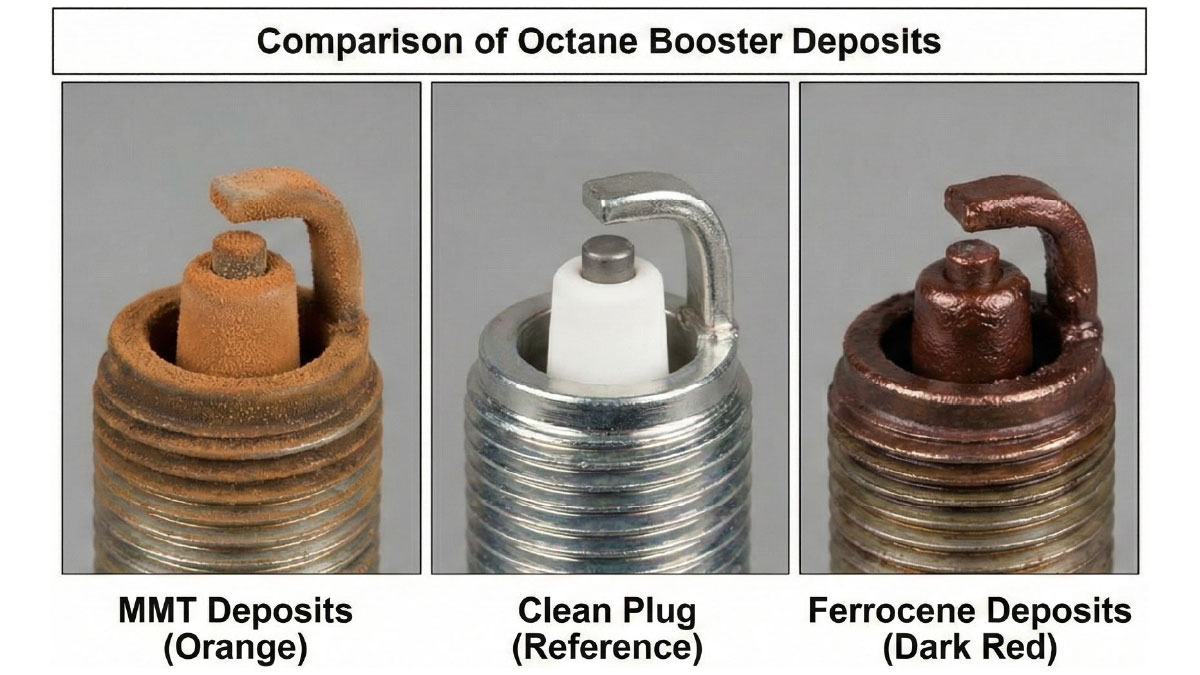
MMT is the "heavy hitter" in many pro-level boosters because tiny concentrations can significantly increase knock resistance. The trade-off is orange manganese-oxide deposits on plugs and sensors, especially with frequent or excessive dosing. Used occasionally or at street doses, many enthusiasts accept the deposits as a performance trade.
What you'll see: orange/red dust on plugs, sometimes on O2 sensor tips. This is why "race dosing" every tank is a bad idea for a daily driver.
Ferrocene (iron-based)
Ferrocene can also raise octane, but iron oxide deposits can be more abrasive and (in some cases) more conductive than MMT deposits. That can accelerate plug fouling or misfires in sensitive applications. If you're choosing between similar performance, MMT concentrates are typically the more common enthusiast "risk-reward" pick.
Aromatics (toluene / xylene)
Aromatics can raise octane because they're blending components found in gasoline—but small bottles rarely contain enough volume to move a full tank meaningfully. They're more effective when used in large blending quantities (think gallons, not ounces). If you're buying a 12-16oz bottle expecting big gains, it usually won't deliver.
Alcohols (ethanol / methanol)
Alcohols can provide high octane and cooling benefits, but they introduce compatibility concerns: water absorption, phase separation (especially in marine), and corrosion in older fuel systems. Flex-fuel vehicles are designed for it; older cars and boats may not be. Treat alcohol-based "boosting" as a system-level choice, not a quick additive.
Dyno reality: when boosters add horsepower
A booster only "adds power" if your engine is currently losing power due to knock retard, conservative timing, or a tune that expects higher octane than you can buy at the pump. That's why tuned turbo cars often show the biggest gains: higher effective octane lets the ECU hold timing and boost safely.
Below is an example summary of published dyno results frequently cited in the enthusiast world. These numbers should be treated as scenario-specific, not guarantees—ambient temperature, base fuel quality, and tune strategy can change everything.
| Vehicle | Engine type | Baseline fuel | Treated fuel | WHP gain | Torque gain | Why it gained |
|---|---|---|---|---|---|---|
| Dodge Ram 5.7L | NA V8 | 93 | 99 | +17.5 | +30.2 | Maintained peak timing under load |
| BMW 335i | Turbo I6 | 93 | 104.5 | +27.7 | +13.2 | ECU adaptation to higher octane |
| Nissan 350Z | NA V6 | 93 | 101 | +31.8 | +62.2 | Timing advance from knock headroom |
| Nissan GT-R | Twin turbo V6 | 93 | 107 | +176.6 | +143.1 | High-boost tuning enabled safely |
Safety: catalytic converters, O2 sensors, spark plugs
The main real-world downside of effective boosters is deposits. MMT concentrates commonly leave orange manganese oxides on plugs and sensors; heavy or constant "race dosing" increases the risk of plug fouling and catalyst efficiency issues over time. Ferrocene can create iron deposits that may foul plugs faster. Dose conservatively for street use.
Street dosing vs. race dosing
For daily driving, use only the manufacturer's street-safe ratios and treat boosters as occasional protection, not a permanent fuel recipe. Reserve high-dose "race concentrate" use for track days or specific tuning needs. Over-dosing typically doesn't add more power—it mainly increases deposits and cost.
Cost math: octane booster vs. race gas
Race gas is the most consistent way to hit a target octane, but it's expensive and inconvenient. Boosters can be much cheaper per tank when you only need a bump for a track day, travel, or a specific tune. The best option is the one that reliably hits your target with the least hassle.
| Scenario | Option | Example cost | Notes |
|---|---|---|---|
| Need ~100 octane for a track day | Race gas | 15 gal x $15 = $225 | Consistent, but hard to source and transport |
| Need ~100 octane for a track day | Premium + booster | 15 gal x $5 = $75 + ~$30 booster = ~$105 | Portable and customizable; relies on correct dosing |
Mixing calculators
Always follow the manufacturer's mixing chart first. These calculators are a sanity-check to help you plan a tank and compare costs. If you want the highest accuracy, calibrate the "booster strength" value to the brand's published chart for your base fuel and tank size, then save it as your personal preset.
This estimates dose based on your base fuel, target, and a "booster strength" you set from the brand chart.
How to set "Booster strength": If a brand chart says "32oz in 10 gallons raises 93 to 99," that's +6 numbers per 10 gallons. Plug "6" here.
Compare boosters by what they cost you per gallon treated at your real dose rate.
Ranked picks: the best octane boosters
If you need a real octane jump for a tuned turbo car or track map, choose a proven race concentrate and follow the mixing chart precisely. If you only need a small cushion for heat, towing, or mild knock, a street booster can work. These picks are ordered by octane ceiling, then value and daily usability.
Quick Summary: Winners by use-case
For maximum octane ceiling, BOOSTane Professional is the "go big" option. For track-day value and availability, VP Racing Octanium (Unleaded) is hard to beat. For older-school builds that want consistent results and don't mind messy handling, Torco remains a benchmark. Street boosters (Royal Purple, Lucas) are best for mild needs.
| Product | Best for | What to know |
|---|---|---|
| BOOSTane Professional | Overall Winner High-HP tuning |
High ceiling race concentrate; requires correct dosing; expect orange deposits if overused. |
| VP Racing Octanium (Unleaded) | Best Value Track days |
Great availability; typically needs a heavier dose vs the most concentrated options. |
| Torco Accelerator | Legacy builds Domestic V8s |
Consistent results; can be messy and light-sensitive; follow mixing carefully. |
| Royal Purple Max-Boost | Street performance Mild knock margin |
Lower ceiling, more "daily" positioning; good when you don't need big numbers. |
| Lucas Oil Octane Booster | Budget / towing Older engines |
Good "everywhere availability" option; not intended for high-boost import builds. |
1. BOOSTane Professional
Choose BOOSTane Professional when you need the highest practical octane ceiling from a portable concentrate—especially for tuned turbo platforms that are knock-limited on pump fuel. The trade-off is cost and the typical MMT "orange dust" reality if you overuse it. Follow the brand chart and treat it like a tool, not a daily habit.
Best Overall & Highest Ceiling
The Bottom Line: If you're chasing a specific target—like a 100-104 octane map—BOOSTane is one of the most common enthusiast picks. Many users prefer it for modern direct-injection platforms (BMW B58/S58, Audi 4.0T, Nissan VR38) where timing pull is sensitive.
Pros
- Very high effective octane ceiling when dosed correctly.
- Widely discussed mixing guidance (charts / apps).
- Portable alternative to hauling race gas.
Cons
- Expensive per treatment at high doses.
- Orange deposits on plugs/sensors if used frequently.
2. VP Racing Octanium (Unleaded)
VP Racing Octanium (Unleaded) is the best pick when you want a trustworthy, widely available track-day booster and you're okay using more volume to hit your target. It's a strong "value per treatment" option compared to the most concentrated bottles. Make sure you're buying the unleaded version if you have catalytic converters.
Best Value for Track Days
The Bottom Line: VP is a motorsports staple, and Octanium is popular because it's easy to buy and dose reliably. If you're using it to add margin—not chase the absolute maximum octane ceiling—it's a practical choice.
Note: VP also sells leaded options. Leaded products can damage O2 sensors and catalytic converters quickly. If your car is street driven with emissions equipment, avoid leaded formulas.
Pros
- Great availability and bulk pricing potential.
- Reliable "track day" use-case.
- Simple dosing (when following the chart).
Cons
- Can format may be awkward to pour/reseal.
- Often requires more volume to match the most concentrated boosters.
3. Torco Accelerator
Torco is a legacy benchmark that many tuners trust because it's consistent and well-known. It's a solid choice for older-school builds and repeatable track usage. The downsides are handling (messy, can-based) and storage sensitivity—keep it sealed and away from light and heat. As always, correct mixing matters more than the brand name.
Benchmark Blend for Legacy Builds
Pros
- Long-running reputation in the tuning world.
- Consistent performance when stored and mixed correctly.
Cons
- Messier to handle; can be harder to pour.
- More sensitive to storage conditions than some bottles.
4. Royal Purple Max-Boost
Royal Purple Max-Boost is best when you want a modest knock safety margin for street driving (heat, towing, mild ping) and you're not trying to hit 100+ octane. Treat it as a street-oriented booster, not a race concentrate. If your tune truly requires higher octane, move up to a concentrate or change the tune.
Best for Street Performance
5. Lucas Oil Octane Booster
Lucas is a sensible "everywhere" option for older engines that need help with mild ping, especially under load (towing, hot climates). It's widely available and affordable, but it's not designed to replace race fuel for high-boost tuned applications. If you're chasing full-number octane increases, you need a different category of product.
Best Budget / Widely Available
How to choose (3 buyer personas)
People search "octane booster" for different reasons. Tuners need measurable octane numbers and safe dosing. Skeptics need evidence, clarity on "points," and chemistry transparency. Daily drivers usually need a quick fix for pinging or misfueling. Choose a product category that matches your intent, not just the most hyped brand.
Persona A: The Tuner (technical / transactional)
If your tune expects 93+ but you only have 91 available, a concentrate can create the safety margin you need. Prioritize published mixing charts, repeatability, and knowing the trade-offs (MMT deposits). Use data logging (knock, timing, IATs) to verify the tank, not seat-of-the-pants feelings.
- Best fits: BOOSTane Professional, VP Octanium, Torco
- Decision rule: If you're chasing 96-104 AKI targets, avoid "points-only" products.
Persona B: The Skeptic (research / informational)
Most frustration with boosters comes from misunderstanding "points" and expecting power on an engine that isn't knock-limited. Look for objective signals: ingredient transparency, realistic claims, and published test scenarios. If a label promises big gains from a tiny dose with no specifics, treat it as marketing, not engineering.
- Best fits: Start by reading the "Points vs Numbers" section and the safety trade-offs.
- Decision rule: If you can't find a dosing chart, you can't verify a result.
Persona C: The Desperate Daily (problem solving)
If your goal is "stop pinging today," start with driving behavior and fuel dilution. A street-oriented booster can help as a mild margin, but persistent ping indicates an underlying issue (heat, bad fuel, carbon, wrong plugs, etc.). Use booster as a short-term aid, not the primary fix.
- Best fits: Lucas Oil, Royal Purple (mild needs) + immediate premium fuel dilution.
- Decision rule: If knock is severe, don't "floor it and hope." Correct the fuel first.
Frequently Asked Questions
These are the most common "People Also Ask" questions about octane boosters. If you're in a hurry, read the first sentence of each answer (optimized for quick extraction), then expand into the sections above for the nuance and the "why."
Can I mix different brands of booster?
Usually no. Different carrier solvents and additive packages can mix unpredictably, causing separation or inconsistent dosing. If you want to switch brands, run the tank low and start fresh on the next fill to reduce the chance of odd interactions.
Does octane booster expire?
Unopened boosters can last years if stored sealed, cool, and out of sunlight. Metal cans often outlast plastic bottles. Once opened, try to use within ~12 months to reduce evaporation and contamination risk. If a product separates, thickens, or smells abnormal, discard it.
Will octane booster fix 87 in a premium-only car?
It can help, especially if you add it early and drive gently, but dilution with premium fuel is usually the quickest and safest correction. For turbo/tuned cars, avoid heavy load until the tank is brought back to a safe effective octane.
Is octane booster safe for catalytic converters?
When used at street-recommended doses, many enthusiasts run MMT-based boosters without immediate catalyst failure, but frequent high-dose use increases deposit risk and can reduce catalyst efficiency over time. If emissions longevity is a priority, limit race dosing and avoid leaded formulas.
Do octane boosters add horsepower on a stock car?
Usually not. If your stock engine isn't knock-limited on its required fuel, higher octane won't add power. The benefit is protection and consistency in harsh conditions (heat, towing, low-quality fuel). You'll only feel gains if the ECU was pulling timing from knock.
Is race gas better than booster?
Race gas is generally the most consistent path to a target octane. Boosters are about convenience and customizing a tank when race gas is expensive or unavailable. For consistent competition use, race gas often wins; for travel and occasional track days, boosters are practical.
Editorial policy & data sources
This page is designed to be a "source-of-truth" reference: we separate measurable claims from marketing language, define terms like "points vs numbers," and surface trade-offs like MMT deposits. We strive to incorporate first-party dyno charts, lab reports, and photos to verify all claims.
- Disclosure: Links may be affiliate links (marked with
rel="nofollow sponsored"), which helps support the site.